Fakhraai Group Publishes Work in Nature Physics
Work supported by the Wisconsin MRSEC has resulted in a publication in Nature Physics. The work led by Zahra Fakhraai at the University of Pennsylvania Department of Chemistry focuses on the effect of size, geometry, and interface interactions on the thermodynamics and optical properties of nanostructured materials. Dr. Fakhraai is a member of the Wisconsin MRSEC IRG 1.
Quantification of Elastic Barriers to Rearrangement in Molecular Glasses
When a liquid is supercooled below its melting point, the relaxation barriers increase rapidly, and the system falls out of equilibrium. The origins of the growing relaxation barriers leading to non-Arrhenius dynamics have been extensively debated. There are two leading hypotheses:
- A growing number of cooperative rearrangements between neighboring regions, with growing length scales that diverge upon supercooling
- Growing elastic barriers due to increased density and thus elasticity in the system.
The former hypothesis leads to a buried phase transition, while the latter presents a smooth transition through a regime where local barriers dominate the properties at high temperature to a regime where elastic barriers are larger than the local ones, leading to arresting dynamics.
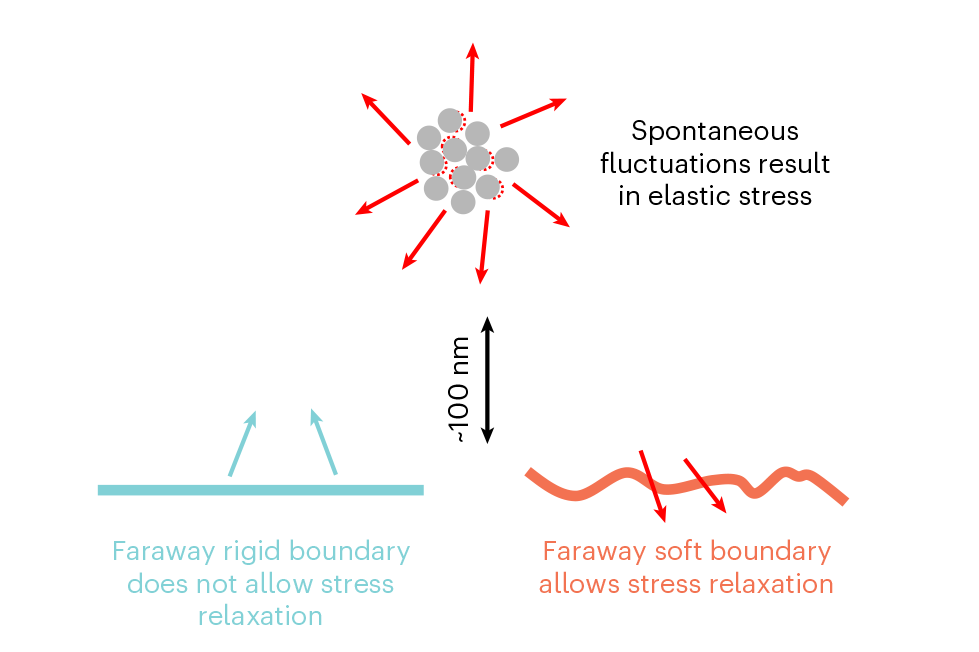
We probe the elastic barriers by monitoring dynamics at an interface between a stable glass produced by PVD and a liquid-quenched glass. The interface is placed 50 nm away from substrates of varying elasticity. On soft substrates, elastic stresses can relax through the faraway interface, while on rigid ones, the stress would build up in a manner similar to a bulk glass. As such, when elastic barriers become dominant, we can monitor the differing relaxation barriers. We observe that at temperatures close to and below the glass transition temperature (Tg), the relaxation barriers are indeed different depending on the substrate used, at distances up to 100 nm away from the interface. While on rigid barriers non-Arrhenius bulk-like behavior is observed, the relaxation remains Arrhenius (constant barrier size) on soft substrates. This allows us to experimentally measure the elastic contribution to the relaxation barrier, and show that it exceeds the local barrier just below Tg. As such, without any cooperative motion, the rise of elastic barriers can lead to vitrification on rigid substrates, and by extension in a bulk glass.
Citation:
Luo, P., Lin, Z., Cao, Y., Jha, K., Wolf, S. E., Govind, S., Bonilla-Lugo, J. I., Stephens, R. B. & Fakhraai, Z. Quantification of elastic barriers to rearrangement in molecular glasses. Nature Physics, (2026). DOI: 10.1038/s41567-026-03394-1