Spin-Triplet Paired Wigner Crystal Stabilized by Quantum Geometry
Research from the Wisconsin MRSEC seed on novel electron solids in two-dimensional materials headed by Ilya Esterlis and Alex Levchenko has shown that bilayer electron crystals exhibit a variety of magnetic states depending on the distance between the two layers and the number of electrons in each layer. These results establish bilayer crystals as a promising platform for studying quantum magnetism and provide guidance for experiments characterizing electron solids realized in 2D materials.
Dmitry Zverevich presented the poster on this research in June at the ESW26 – Workshop on Recent Developments in Electronic Structure where he won an award for the poster.
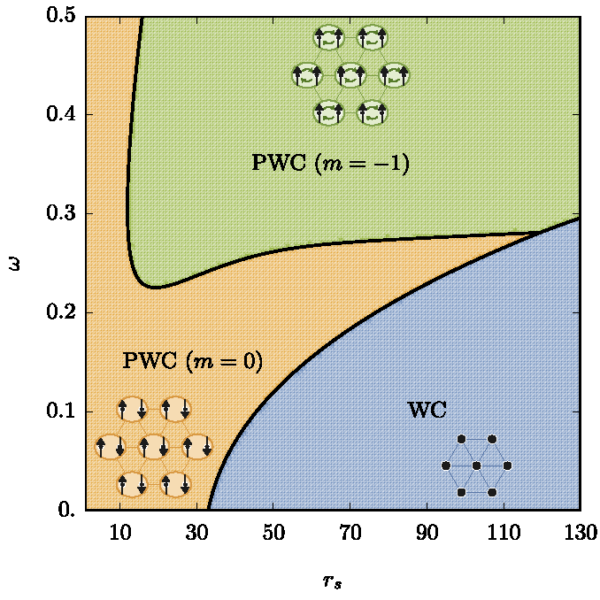
At low enough densities, electrons stop flowing like a liquid. Their mutual repulsion overwhelms their motion, and they freeze into an orderly lattice, called a Wigner crystal, with one electron at each site. First predicted in 1934, such crystals made of electrons have recently been observed, and even directly imaged, in atomically thin materials like graphene and semiconductor monolayers. Many of these materials share a subtle feature called quantum geometry: electrons’ wave functions twist as they move.
How does quantum geometry reshape the crystal? Using variational calculations, the researchers find it strengthens electrons’ tendency to occupy lattice sites in pairs. When the quantum geometry effects are strong enough, the pairs change character. The two electrons align their spins, forming a “spin-triplet” state, and circle each other with nonzero angular momentum. This can be understood from a simple picture of two electrons trapped in a tiny “quantum dot” formed by their neighbors.
The pairing arises purely from electron repulsion and quantum geometry. If the paired crystal melts, the pairs might survive and flow without resistance. That could produce an unconventional, spin-triplet superconductor, possibly linked to the chiral superconductivity recently seen in rhombohedral graphene.